What Are the Booster Seat Requirements in Georgia?
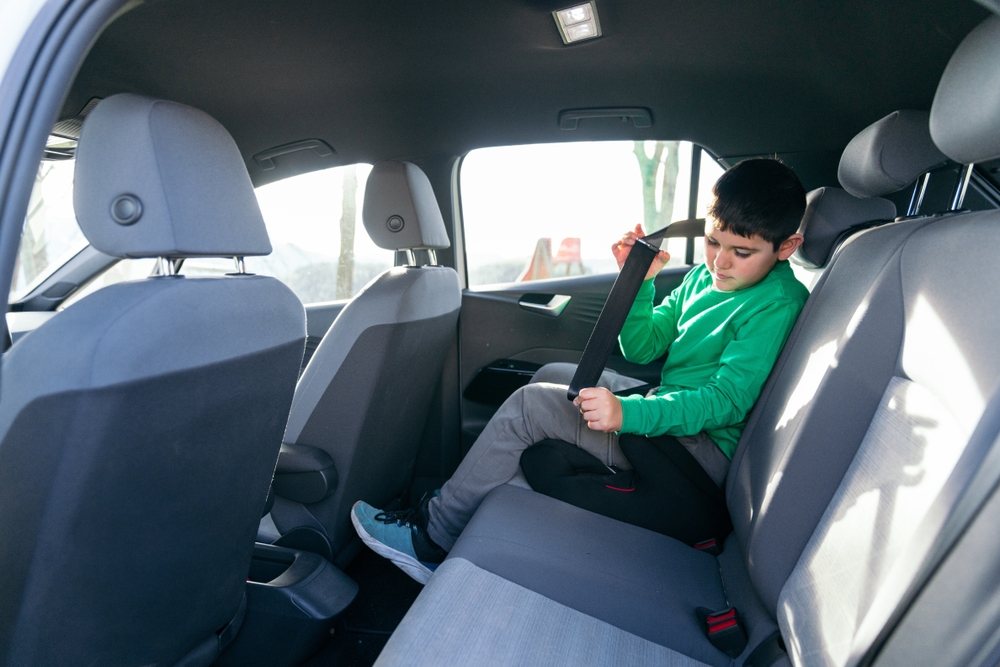
Georgia requires a child to ride in a booster seat or another child restraint until the child turns 8 years old, unless the child is already taller than 4 feet 9 inches. Under O.C.G.A. 40-8-76, the restraint has to fit the child’s height and weight, and the child belongs in the back seat whenever an appropriate rear position is open.
- Under 8 years old: a car seat or booster seat is required
- Taller than 4 feet 9 inches: a regular seat belt may be used instead
- Back seat first: the front seat is allowed only when no appropriate rear position is available
Children 8 and older no longer need a booster, though Georgia still requires them to buckle up.
With more than 2,600 children under the age of 13 being seriously injured in car crashes every day in the United States, according to the NHTSA, the state of Georgia has issued legislation to ensure children are safely secured in a child passenger restraint system when riding in a vehicle.
According to Georgia Code 40-8-76, children under eight years of age must ride in an approved child restraint system and be restrained by a safety belt approved by Federal Motor Vehicle Safety Standard 208.
Safety standards require that all designated seating positions in a vehicle have a Type 1 seatbelt (lap belt) or a Type 2 (lap and shoulder belt) seat belt assembly with a detachable upper torso portion.
Key Takeaways
- Georgia’s child restraint rule applies to every child under 8 years old riding in a car, van or pickup truck on a public road.
- A booster seat is the right stage once a child outgrows a forward-facing harness but is still shorter than 4 feet 9 inches.
- Height ends the booster requirement early. A child under 8 who is over 4 feet 9 inches may use a seat belt instead.
- Children under 8 belong in a rear seat unless the vehicle has no rear seat or every appropriate rear position is taken by other children.
- A first child restraint citation carries a fine of up to $50, and a later one up to $100.
- Georgia changed its rules on seat belt evidence in 2025, which affects how insurers argue injury claims involving unrestrained passengers.
Georgia Laws and Regulations Pertaining to Car Seats and Booster Seats
A sobering statistic in Georgia is that automobile accidents are the leading cause of death and injuries for children ages 1 to 12 years old, according to the National Highway Traffic Safety Administration (NHTSA). A major contributor to these horrific accidents is the improper use of car seats. Studies by the NHTSA have shown that when car seats are used correctly, they are 71% effective in preventing injury among infants and 54% for children ages 1-4.
Georgia lawmakers are also making an effort to lower these statistics by passing strict laws and regulations for car seat safety. According to the most current Georgia Laws:
- All children under the age of eight whose height is less than 57 inches must ride in the back seat of a car. This is to protect them from the force of the airbag in case of an accident. Airbags are meant for adults and can be harmful to children.
- Children under the age of eight are required to be in a car seat or booster seat suitable for their age and height.
- Vehicle with no back seat (e.g., truck, 2-door coupe), or if the back seat is taken by other children, Georgia Law allows a child under the age of eight to sit in the front as long as the proper car seat or booster is utilized.
- If an officer observes a seat belt offense, then under Georgia’s Primary Safety Belt Law, they can pull the vehicle over and issue a citation.
Penalties for Violating Car Seat Laws in Georgia
- Fines: A first-time offense will result in a $50 fine, while subsequent violations will cost up to $100.
- Points on Your License: Each violation adds one point to your driving record.
- Increased Insurance Rates: Accumulating points can lead to higher insurance premiums.
Georgia Booster Seat Requirements by Age, Height and Weight
A booster seat is required in Georgia once a child outgrows a forward-facing car seat and before that child either turns 8 or grows past 4 feet 9 inches tall. The statute sets the rule by age, then uses height and weight to decide which restraint actually fits.
Here is how the requirement lines up stage by stage.
| Child’s stage | What Georgia law requires | Where the child rides |
| Under 8, shorter than 4 feet 9 inches | A child passenger restraint suited to the child’s height and weight, installed and used per the manufacturer’s directions | Rear seat, unless no appropriate rear position is open |
| Under 8, taller than 4 feet 9 inches | A seat belt, under the height exception written into the statute | Rear seat is still the safer choice; belt fit is what the law looks at |
| Under 8, at least 40 pounds, no lap-and-shoulder belt free | A lap belt is permitted in that narrow situation | Rear seat, unless no appropriate rear position is open |
| 8 through 17 | A seat belt in any seat of the vehicle | Front or rear |
| 18 and older | A seat belt in the front seat | Front seat occupants must be restrained |
Weight matters most in the middle years, because a harness has a manufacturer weight limit and a booster does not fit a child who is still under it.

When a Child Can Move Out of a Booster Seat
A child is ready to leave the booster when the seat belt fits the way it was designed to fit, not simply when a birthday arrives. The lap belt should sit low across the upper thighs and the shoulder belt should cross the middle of the chest and shoulder.
The child should also be able to sit all the way back with knees bending at the edge of the seat for the whole ride. NHTSA publishes fit guidance that goes further than the legal minimum, which is worth following even after the law stops requiring a booster.
Front Seat Exceptions Under Georgia Law
Two situations allow a child under 8 to ride up front. The vehicle may have no rear seating position suitable for a restraint, as with a regular cab pickup, or every appropriate rear position may already be occupied by other children.
In both cases the child still has to be properly restrained for their height and weight. There is also a medical exception when a parent or guardian holds a physician’s written statement that a condition prevents the required restraint.
What Does Georgia’s Seat Belt Law Require?
O.C.G.A. 40-8-76.1 requires every front seat occupant of a passenger vehicle to be restrained, and it requires every minor from 8 through 17 to be restrained in any seat. "Passenger vehicle" is defined broadly.
- Front seat: the driver and any front passenger must be buckled, whatever their age
- Rear seat: minors 8 through 17 must be buckled, and the driver can be cited when they are not
- Pickup trucks: pickups count as passenger vehicles, right alongside vans and SUVs
- Farm use exception: the requirement does not reach a pickup being used for the usual farming work of an occupant 18 or older
That last exception is narrow and comes up mainly on working land, which still matters in parts of Hall and Forsyth counties. A driver who does not buckle up faces a fine of up to $15, and a driver who fails to secure a minor age 8 or older faces up to $25.
Does a Restraint Violation Affect a Child Injury Claim?
Not on its own. Georgia law states that a violation of the child restraint statute is not negligence per se or contributory negligence per se, and that it cannot be used as a basis to cancel insurance coverage or raise rates. A booster seat mistake does not hand the other driver a defense.
The rule for older passengers did change. Senate Bill 68, signed in April 2025, amended 40-8-76.1(d) so that a person’s failure to wear a seat belt may now be considered in a civil case on questions of negligence, comparative negligence, causation, assumption of risk and apportionment of fault.
A judge still weighs whether that evidence is more useful than it is prejudicial before a jury hears it. The change reaches cases commenced on or after April 21, 2025.
Fault percentages carry real weight in Georgia because of O.C.G.A. 51-12-33. A person found 50% or more at fault recovers nothing, and anything below that reduces the award by the same share.
We have spent 25 years handling crash claims in Hall and Forsyth counties, and we see adjusters reach for the restraint question early, often before the medical picture is even clear. Our Georgia car accident lawyer team answers that argument with the crash physics and the medicine rather than with assumptions about a car seat. Families closer to home work directly with our Gainesville car accident attorneys, a few minutes from the Hall County Courthouse.
Related Georgia Driving Laws That Come Up in These Cases
Child passenger cases often turn on what the other driver was doing. Georgia’s distracted driving law and the Hands-Free Georgia Act both shape how we prove a driver looked away from the road before impact.
For your free consultation, call us or contact us online now.
Can I File a Lawsuit on Behalf of My Child?
When a child is injured in a car accident, they reserve the same right as an adult to recover compensation. However, a child cannot file a lawsuit or pursue legal action under Georgia Law, nor are they permitted to enter into settlement agreements. Instead, parents or legal guardians have the option to file a lawsuit on behalf of their child.
If the parent does not want to file a lawsuit, they can wait until the child is eighteen years old and considered an adult, so they can file a lawsuit on their own behalf. According to the Statute of Limitations in Georgia, a minor has two years from the day they turn 18 years of age to file a personal injury lawsuit.
Compensation Available for Child Injury Cases
The value of a child injury claim varies widely from case to case. The amount of compensation your child can receive will be largely dependent on the financial value of their losses.
Childhood injuries can cause permanent impairments and significantly impact their future. Also, if their injury requires extensive and ongoing treatment, then the value of their case will most likely be relatively high. Here is a list of factors that may contribute to the value of your child’s injury claim:
- The severity of your child’s injury
- The cost of your child’s medical treatment to date
- Any special needs created by the injury
- Whether your child requires ongoing medical care, rehabilitation, or therapy
- The expected long-term impact and recovery time
- Your child’s educational prospects and earnings after the accident
- Changes to your family’s quality of life post-accident
FAQs about Booster Seat Requirements in Georgia
Parents ask us these questions most often after a crash, and the answers are worth knowing well before one happens.
Do Georgia booster seat rules apply in an Uber or a taxi?
The child restraint statute carves out taxicabs and public transit vehicles, so the legal answer differs by vehicle type. Rideshare vehicles are private cars rather than taxis, and rideshare companies set their own policies on top of state law. Bringing your own booster is the practical way to keep a child protected on those rides.
How long should a child stay rear-facing in Georgia?
Georgia law does not set a rear-facing age, so the manufacturer’s height and weight limits govern. Most convertible seats today allow rear-facing well past a child’s second birthday. Staying rear-facing to the top of that range gives a young neck and spine more support in a frontal crash.
Is a secondhand car seat allowed under Georgia law?
Nothing in the statute bans a used seat, but the law does require the restraint to be installed and used according to the manufacturer’s directions. That is difficult with a seat that arrived without its manual, its labels or its history. A seat involved in a prior crash, or one past its expiration date, should be replaced.
Do Georgia booster seat rules apply to families visiting from another state?
Yes. The requirement follows the road, not the license plate, so a family driving into Georgia for a weekend at Lake Lanier is subject to Georgia’s rules. Families heading north into Tennessee or North Carolina should check those thresholds too, because the ages and heights are not identical.
Does a car seat violation put points on a driver’s license?
A child restraint conviction is reported to the Department of Driver Services and can carry a point in addition to the fine. A seat belt violation under the separate belt statute is treated differently, since the law says it is not a moving violation for point purposes. The two citations look similar on a ticket and are handled differently.
Do school buses have to use child restraints in Georgia?
School buses sit outside the child restraint requirement, which is why you do not see harnesses on a full-size route bus. Smaller buses run by licensed child care facilities are treated differently, and children between four and eight riding those vehicles generally need a restraint. Field trip vehicles vary, so it is fair to ask the operator directly.
Talk With Our Gainesville Team About Your Child’s Injury Claim
Seeing your child hurt in a crash is a different kind of hard, and the paperwork that follows arrives at the worst possible moment. We can take that part off your hands while you focus on appointments and recovery.
Weaver Law Injury Attorneys has been trusted in Gainesville for over 25 years, with more than 110 years of combined experience across our team and offices in Gainesville, Cumming and Murrayville. Our clients get our cell numbers, not a call center, and they reach us any hour. We have recovered more than $175 million for injured Georgians, though past results do not guarantee the outcome of any future case.
Call 770-415-5555 for a free consultation. There is no fee unless we win.